Showing posts with label ruthpauline. Show all posts

Tuesday, December 1, 2015

Halika, Kain Tayo!

For the great finale of this funny, wonderful, totally amazing blog, we decided to do a legitimate study on one of the five senses in the body: taste.

A lot of research goes into food. This is typical, as food is one of the basic human necessities. From childhood, the four basic tastes taught by the basic education system is: sweet, sour, salty, and bitter. There’s a new taste in town however, and it’s called umami. It’s still a little bit controversial, in the sense that some people still refuse to recognize it as a basic taste. Umami is a Japanese word, meaning savory.

Through these four basic tastes, a lot has been discovered. The chemicals that can provide these tastes, the taste receptors that recognize these tastes, and from which specific cortex the tastes are recognized in the brain. Perception psychology has contributed a lot to data regarding taste.

As psychology majors, it’s our job to be able to think up of new ways of researching for more data on food, like figuring out which factors or social constructs are able to affect the way we perceive food. After all, we Filipinos take pleasure in eating with others, even when all we have are two hands and one big banana leaf in front of us. Food just seems so much tastier with great company, which is why we never hesitate to go to the next fiesta spread or to go try new restaurants with the barkada. Eating with friends is a way to celebrate our ups and downs in life as well, whether it’s pigging out after passing a hard exam or comfort eating together after a bad breakup. Since previous research indicates that moods always affect your perception of things, we decided to research on the effect of mood and relationship closeness on taste perception, namely for the sweet taste in cookies.

A well-timed study, considering that Christmas feasts will be starting soon.

In our environment where everything happens, any event that catches our attention might influence and change our moods. Mood is a "general and pervasive feeling state that is not directed toward a specific target” (Wood, Saltzberg, and Goldstampt, 1990) which occurs as a response to situations that happen in the environment (Isen, 1984). On the other hand, relationship closeness is pretty similar to our concept of kapwa. It’s when our representation of the self or ‘me’ as being a part of our representation of others. So the higher the relationship closeness, the greater the overlap between the ‘self’ and ‘others’(Aron & Fraley, 1999).

Previous research has already shown that we tend to eat more when we’re around other people, especially if it’s people that we know (Hetherington, Anderson, Norton, & Newson, 2006). While that doesn’t necessarily mean that we taste differently when we’re around other people, research has also found that eating chocolate together with someone else enhances how much we like or dislike the chocolate (Boothby, Clark, & Bargh, 2014). As for mood, depressed people tend to taste sweetness and bitterness more intensely after feeling a positive or negative mood (Platte, Herbert, Pauli, & Breslin, 2013). But is this true even for the non-depressed?

For our experiment, we looked for 120 volunteers from the Psych 101 subject pool. Days before our actual data gathering schedule, we posted several sign-up sheets for an experiment entitled COOKIE MONSTER (we even drew a cute Cookie Monster on it) on a bulletin board near the classrooms hoping that the students would be interested in participating. Luckily, throughout our data collection we did not have any problems looking for participants (in fact the challenge was how to accommodate all the students who wanted to walk-in). In the end we only had time and research participation credits for 124 participants but at least it's 4 more than our initial intended number.

cookiemonster1.jpeg
Cookie says Hi!
For our experiment, we looked for 120 volunteers from the Psych 101 subject pool. Days before our actual data gathering schedule, we posted several sign-up sheets for an experiment entitled COOKIE MONSTER (we even drew a cute Cookie Monster on it) on a bulletin board near the classrooms hoping that the students would be interested in participating. Luckily, throughout our data collection we did not have any problems looking for participants (in fact the challenge was how to accommodate all the students who wanted to walk-in). In the end we only had time and research participation credits for 124 participants but at least it's 4 more than our initial intended number.

Upon arrival outside the experiment room, we asked the participants if they came with a friend or if they signed-up for a solo/stranger slot. Of course, being the sigurista experimenters that we were, we re-checked and quantified the relationship levels of the participants using both a qualitative (small talk while waiting for their turn) and a quantitative method (Person Scale & Interpersonal Solidarity Scale which was administered in the middle of the experiment).

Our actual experiment involved 8 phases that would take about 20-30 minutes in total. A pretty good cover-up story was also used to divert the attention of the participants from guessing our real research objective and to justify the fact that they had to eat the cookies provided while inside the room. Don’t worry; we debriefed our participants before letting them go so there was no harm done besides that of the minimal deception.

We told our participants that we wanted to see how a shared experience, like watching a video, affected their perceived closeness to each other. The mood scales were there, we said, just so that we could check if they were feeling any extreme emotions that could affect the results. As for the cookies, they were told that they were actually free cookies provided by our sponsors!

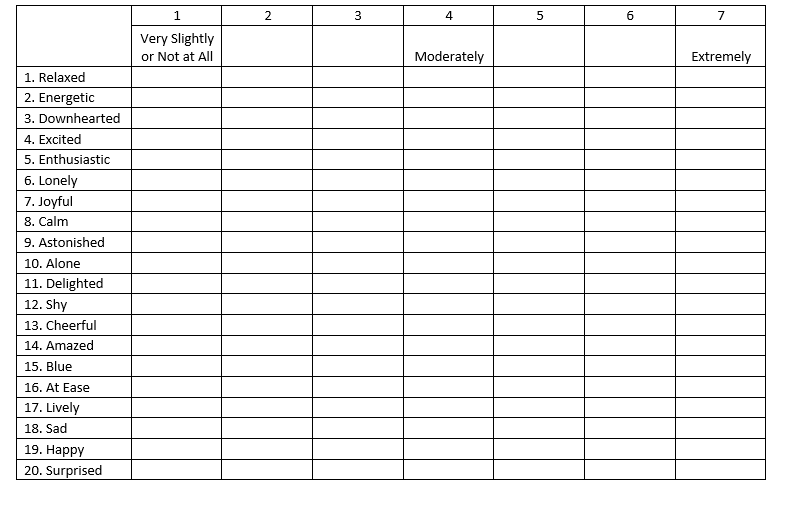
Anyways, going back to the experiment procedures, the first thing we did upon the arrival of the participants was to give them a consent form and to instruct them about what they would do. Once they agreed to participate, we administered the PANAS-X test to determine a baseline of their moods. Since in this research we are looking at the effects of mood and relationship closeness on taste perception, after they have answered the aforementioned scale, we presented them with either a happy video or a sad video to alter their moods. For the happy condition, we used one of the impossible challenges try not to laugh videos you can find in YouTube. In the same way, we used 2 Thai insurance commercials (those that make the ninjas inside the room cut onions…) from YouTube to induce the sad mood. Ok, so now the question is whether the videos worked. Statistical analysis showed that the videos were effective, so effective in fact that during the experiment the participants were either laughing their hearts out or trying to stifle their tears.

Impossible Challenge
My-Dad-is-a-Liar-Emotional-Commercial.jpg
My Dad is a Liar
1241.jpg
Silence of Love
      
So now comes the cookie. Each participant was given one cookie to eat while they watch the video. The cookies provided were homemade and baked the day before the experiment. We altered a cookie recipe readily available online to make them taste less sweet and we removed the chocolate chips and nuts so as to make the cookies as simple as possible. You can find the actual recipe we used to for the cookies before the references part of this blog. You guys should try it sometime especially if you are fond of not too sweet desserts.

PANAS v. 1
Once the participants have finished watching the videos (and ideally eating the cookie), they were given the Interpersonal Solidarity Scale and the “Person Scale” to quantitatively measure the participant’s closeness. Then the participants were asked to answer the PANAS scale again but in a different presentation so as not to make them realize that they are answering a form identical to the one given previously. Finally they were asked for feedback on the video and the cookie.

PANAS v. 2
*Would you believe that these two are actually identical?
The Person Scale

When we searched the vast ocean of research, we found several studies that stated being happy increased the perception of sweetness (Boothby, Clark, & Bargh, 2014;Platte, Herbert, Pauli, & Breslin 2013). Unfortunately, it was not to be. There are, after all, other studies that did not obtain a significant perception of sweetness (Dichter et al., 2010), and ours happened to be one of them. Perhaps Filipinos are just so accustomed to sweet cuisine, that it affected our perception of sweetness.

We did find some pretty interesting (and sometimes unexpected) results though. In fact, there was a positive effect of mood induction and relationship closeness on bitterness. This means that those who felt happy and were with a friend actually sensed bitter tastes more accurately. As unusual as it may seem, we also found out that individuals who are with their friends perceived sourness when the positive mood is induced. This might be because an enhanced state of arousal when mood was induced. A similar case happened in Platte, Herbert, Pauli, & Breslin’s (2013) study, wherein they obtained significant sourness scores for both happy and sad conditions! We postulate that while arousal does happen when one is happy or sad, one may become more aroused when happy as compared to sad. There was also an significant interaction between relationship closeness and mood, which affected sour scores. In a way, this wasn’t all that surprising. We do tend to experience greater feelings of excitement when other people are around, especially when they’re people we know.

There still seems to be a long road ahead. Sometimes sweetness doesn’t significantly increase when we’re happy. Maybe we tend to be more sensitive to bitterness when we’re with a friend. Either way, we must continue to search for the tasty truth.

Cookie Recipe

Ingredients:
  2 ¼ cups all purpose flour
  ½ teaspoon baking soda
  ½ teaspoon salt
  1 cup softened butter
  ¾ cups granulated sugar
  ¾ cups packed brown sugar
  1teaspoon vanilla extract
  2 large eggs

Combine flour, baking soda and salt in a small bowl. Beat butter, granulated sugar, brown sugar and vanilla extract in a large mixing bowl until creamy. Add eggs, one at a time, beating well after each addition. Gradually beat in flour mixture.  Drop by rounded tablespoon onto ungreased baking sheets. Finally bake for 9 minutes or until golden brown.

References:

Aron, A., & Fraley, B. (1999). Relationship closeness as including other in the self: Cognitive

underpinnings and measures. Social Cognition, 17(2), 140–160.
doi:10.1521/soco.1999.17.2.140

Boothby, E. J., Clark, M. S., & Bargh, J. A. (2014). Shared experiences are amplified.

Psychological science, 25(12), 2209-2216.

Hetherington, M. M., Anderson, A. S., Norton, G. N. M., & Newson, L. (2006). Situational effects on meal intake: A comparison of eating alone and eating with others. Physiology & Behavior, 88(4-5), 498–505. http://doi.org/10.1016/j.physbeh.2006.04.025


Isen, A. M. (1984). Toward understanding the role of affect in cognition. In Sedikides, C. (1992). Changes in the Valence of the Self as a Function of Mood. Personality and Social Psychology Review, pp. 271-311


Platte, P., Herbert, C., Pauli, P., Breslin, P. A. S. (2013) Oral perceptions of fat and taste stimuli are modulated by affect and mood induction. PLoS ONE, 8(6):e65006. doi: 10.1371/journal.pone.0065006


Wood, J.V., Saltzberg, J.A., & Goldstampt, L.A (1990). Does affect induce self-focused attention? In Sedikides, C. (1992). Changes in the Valence of the Self as a Function of Mood. Personality and Social Psychology Review, pp. 271-311


Photo Credits:


[Photo of a painting of a Filipino family having dinner]. Retrieved from http://static.squarespace.com/static/5411d80ae4b02fc94fefce4a/5457e7a5e4b06c364300fd00/5457e901e4b06c3643013042/1291127341000/G00003.jpg?format=original

Monday, November 2, 2015

Ratatouille: That Sounds Sweet!


Whenever I watch Pixar’s Ratatouille, one of the most fascinating scenes was seeing Emile consume a grape and a piece of cheese while Remy describes the experience. While Remy describes a “creamy, salty, sweet” and “oaky nuttiness”, what I think is a low bass guitar plays softly in the background. As he describes “smooth, crisp, slight tang on the finish”, sweet percussion instruments create an ethereal sound. When Emile eats the two together, an explosion of color and an amalgam of sound occurs. While it may seem like the director Brad Bird used creative license here, he actually wasn’t off the mark. Contrary to popular belief, taste is a multimodal experience. This means that we recruit all 5 senses- hearing, taste, touch, smell, and sight- when we savor our food. In fact, the color (for example, red) can enhance the sweetness of let’s say, strawberries. It’s easy to see how vision or smell might influence taste, but what does hearing have to do with it?

Researchers have already established that we tend to use the same adjectives to describe music and our taste experience (Knöferle and Spence, 2012; as cited by Kontukoski, et al., 2015). For example, “sweet” ,”dry”, “light”, “soft”, and “crisp” are all words I’d use to describe an introductory Disney movie song and a good bag of potato chips. People also take these associations a step further. When musicians were asked to improvise musical theme from basic taste words like “sweet”, “salty”, “bitter”, and “sour”, certain words corresponded to certain musical patterns (Mesz, Trevisan, & Sigman, 2011, as cited by Kontukoski, et al., 2015). Take a look at the song Edeilwess, as sung by Captain Georg Von Trapp (Theodore Bikel) in Rodger and Hammerstein’s Sound of Music.


The flow of the song is consistent, slow, and soft. This was similar to the patterns created by the taste word “sweet”. On the other hand, take a look at the song Your Fault from Into the Woods (2014).

It seems erratic or dissonant as the different characters chirp in with often high-pitched voices. These sort of musical patterns were improvised under the “sour” category. Lastly, “bitter” improvisations were both low-pitched and legato, much like the Gregorian chanting seen at the beginning of The Hunchback of Notre Dame’s Hellfire.


People also link music to other words related to the basic tastes. For example, in Kontukoski, et al.’s (2015) study, people often used the words like “chocolate”, “tasty”, “dessert”, “velvety”, and “creamy” to describe a “sweet” musical piece- all words I’d associate with having a great experience savoring a decadent piece of chocolate cake. On the other hand, people used more “unpleasant” taste sensations when describing “sour” music, like “hard”, “pungent”, “strong”, and “burning”, among others.

Listening to certain kinds of music not only influence associations, but how we choose to act.   Kontukoski, et al. (2015) also asked their participants to mix a drink after listening to a piece of music. When people listened to “sweet” music, their drink had higher sugar content (including honey, mango juice, and pineapple juice). The reverse was found after listening to “sour” music; the drink had more sour ingredients with higher acidity (lemon and pineapple juice).
Dr. Frankenstein was probably listening to some weird music when he made his monster...
While all these things seem to occur in the vacuum of an experiment, these effects are also evident in a world where Top 40 songs are constantly blaring on as we eat at fast food joints. Music may seem like background noise as you concentrate on that juicy piece of chicken in front of you, but it may play a much more important role than many realize. For example, one study (Wang  & Spence, 2015) was set up in a wine tasting event with live classical music. When a high-pitched and fast Debussy piece was played, the wine was given significantly high acidity and low fruitiness ratings. However, the slower Rachmaninoff piece was given the opposite (low acidity, high fruitiness). This was true whether a person was given red wine, which tends to be sweeter, or white wine, which was made to be more sour and citrusy. Looking back on word-associations, this actually makes sense (you’ll have your explanation later, but I don’t want to spoil it for you …try figuring it out). 

They also tried seeing how music influences our experience of an all-time favorite of mine, chocolate (Carvalho, et al., 2015). This time, they used a Brazilian song- a song that wasn’t deliberately manipulated to modulate taste like in previous experiments. They found out that when the participants were told that the chef used the music as his source of inspiration for creating the chocolate, they significantly liked the chocolate more as compared to other conditions wherein they were not told as such. In fact, they enjoyed it so much that they were also the most willing to pay for it! It didn’t matter that the participants didn’t know who the chef was or were unfamiliar with the music, they nevertheless still enjoyed it. This honestly seems like an interesting marketing strategy. Could this be the end of an era where famous
Inspired by Cool for the Summer by Demi Lovato
people create fragrances with their name slapped on it, and the start of a new craze where chefs create mints dedicated to 5 Seconds of Summer’s new album? While it is an interesting proposal, the problem here is that by simply creating an air of likeability for the chocolate (“Wow! The chef handcrafted this chocolate because he was inspired by the music? This is special!”), this may have contributed to the participants’ tasting experience.

But what could be the reason behind these associations and preferences? One fascinating explanation is through the cognitive priming theory. Let us use the aforementioned Debussy piece to argue this case. Because we derive symbolic meaning (a fast pace and high-pitch is related to “sourness”) from the music we hear, we also activate information related to these terms (“sourness” strongly relates to “acidity”). When this happens, it becomes easier to access these ideas when we think about something.  So these associations ("Man, this drink sure has high acidity!") are what we retrieve as we taste and evaluate the wine.

I must end this post with a small word of caution: as with many crossmodal studies, we have yet to truly establish how the relationship between music and taste perception works. But while we can’t definitely say that food tastes better when accompanied by the right music (thanks to priming), it definitely wouldn’t hurt to try eating some French food while listening to the Ratatouille soundtrack.
Carvalho, F. R., Van Ee, R., Rychtarikova, M., Touhafi, A., Steenhaut, K., Persoone, D., & Spence, C. (2015). Using sound-taste correspondences to enhance the subjective value of tasting experiences. Frontiers in psychology,6.
Knöferle, K. and Spence, C. (2012), “Crossmodal correspondences between sounds and tastes”, Psychonomic Bulletin & Review, Vol. 19, pp. 992-1006
Kontukoski, M., Luomala, H., Mesz, B., Sigman, M., Trevisan, M., Rotola-Pukkila, M., & Hopia, A. I. (2015). Sweet and sour: music and taste associations. Nutrition & Food Science, 45(3), 357-376.
Mesz, B., Trevisan, M.A. and Sigman, M. (2011), “Taste of music”, Perception, Vol. 40 No. 2, pp.209-219.
Wang, Q. J., & Spence, C. (2015). Assessing the Effect of Musical Congruency on Wine Tasting in a Live Performance Setting. i-Perception, 6(3), 2041669515593027.

Monday, October 19, 2015

Pitch Perfect 2: How to Get an Earworm

I remember the first time I watched Pitch Perfect 2. When the optimistic freshman Emily started crooning the lyrics to her self-composed song “Flashlight”, I cringed. I just plain hated it, especially it’s repetitive used of the word “Flashlight”. When (spoiler alert!) they start singing the song along with past bellas and confetti fluttering everywhere for the
You're my Flashlight-light-liSHHHHHHUSHH YOU
championship (end of spoiler), I still loathed it. Even when I found out that Jessie J composed the song, I still couldn’t bring myself to care for it. But as fate (and any musically-inspired and popular movie) would have it, the song seemed almost omnipresent on the radio, television, and in any local mall or department store near you. For a time, it almost seemed impossible to avoid it so I just had to learn to live with “Flashlight”. One day, I found myself just strolling about minding my own business, when I started absentmindedly humming the lyrics.
got all I need when I got you and I
I look around me, and see sweet life
I'm stuck in the dark but you're my flashlight
You're gettin’ me, gettin’ me through the night
I stopped in my tracks. For a moment, I was totally mortified. When I got over my initial shock, I began a period of self-loathing. How could I, started humming along to its deplorable tune? As I engaged in a battle between hating the song, Pitch Perfect 2, Jessie J, and myself, the song “Flashlight” continued to loop in the background of my mind.
We’ve all had our own experiences of a song abruptly popping into our head and constantly repeating itself like a broken record, but what is this particular phenomenon called? In Germany, the phenomenon was coined Ohrwurm (Williams, 2015). From this point, different names were spawnedsuch as Korvamato (Finnish), Oorworm (Dutch), and amusingly enough, Canzone tormente (Italian) which- if I had to guess- means song of torment.
It’s currently  known as “earworm” in English, but has also been called a brainworm and stuck song syndrome, among others. An earworm happens when a person experiences a short melody which gets stuck in the mind and just keeps repeating beyond a person’s control. However, just because you are experiencing an earworm doesn’t mean that you have a psychological disorder. Earworms are different from hallucinations, since hallucinations are seen as coming from outside and not within your mind. Current research links it to the term ‘Involuntary Musical Imagery’ (INMI). Depending on who you ask, it is synonymous  to INMI(Floridou, Williamson, & Mullensiefen, 2015) or is seen as a type of INMI (Williams, 2015). The INMI has been coined as the process of accessing perceptual information from memory, which brings about involuntary hearing of a song in the ‘mind’s ear’. Seeing the two definitions alongside each other, I can see why current researchers are in an epic struggle to differentiate the two (if that was ever really necessary).
Not really sure if you’ve experienced an earworm? Let’s try describing some general conditions for you, dear reader. Earworms usually last minutes to hours, but don’t usually last beyond 24 hours (Halpern & Bartlett, 2011).It also usually isn’t on constant repeat. Much like a dog who enjoys running away and coming home to eat every day, the song sometimes leaves one’s conscious awareness, only to come back later. Sometimes, one earworm would replace another and continue to co-exist in such a manner. Unless you are just plain crazy for that song, this is a good thing; having one song replay for the rest of my life sounds like a real nightmare. Another notable manifestation of an earworm is the fact that only a small part of the song repeats in a person’s mind, with the brain often favoring a certain part of the song (Beaman & Williams, 2010; Hyman et al.,2015). Puzzled? Take a look at my story again, specifically the lyrics. These lyrics are a part of the song called the chorus, and it is these lines that often repeat over and over again. Don’t get me wrong, it’s still possible to have a full song mentally replaying, but most people find themselves unable to complete it. This is because we often find it difficult remembering the next lines following the chorus, so we ending up with a chorus that just keeps on looping.
Research looking into earworms and INMI is relatively young and the causes of earworms are still pretty unclear, although some researchers have tried giving some possible causes. Floridou, Williamson, & Mullensiefen (2015) narrowed it down into three factors: the music, the situation, and the person. Let’s try scrutinizing some movie scenes and my own “earworm” experience and see if they check out.
Certain song qualities increase the chances of turning the latest pop song into an ear worm. Let’s look back at the earlier example. According to Kellaris (2001; as cited by Floridou, Williamson, & Mullensiefen, 2015), INMI is kind of like a cognitive itch that happens when the “music mosquito” with the right qualities comes along- namely repetition, musical simplicity, and incongruity. Repetition is certainly straightforward, if you repeat a phrase or motif often enough, it becomes a lot easier to remember. The song “Flashlight” is a perfect example, they pretty much repeat the song title several times in the chorus. For Pete’s sake, the chorus ends with the phrase “You're my flash light, you're my flash light” repeating over and over again. Musical simplicity ( a quality that many children’s songs have), is pretty much a staple of pop music. In the end, “Flashlight” possesses all the right ingredients- enough of a unique flavor in terms of rhythm (incongruity), repetition of words, especially flashlight, and musical simplicity- to create the perfect earworm. On to the next step!
"I know that song-Santa's Super Sleigh!"
kid Spock-like Nicholas Hoult> "heartthrob" Nicholas Hoult
As always, context is important. What we might be experiencing or environmental events may be enough to trigger an earworm. In fact, Beaman & Williams (2010), claimed that recent musical exposure carried more weight than the qualities of musical structure like repetition. In fact, recent exposure can be used to explain why people often report playing Christmas songs in their heads during the holidays (Halpern & Bartlett, 2011). Let’s use About A Boy as an example for this case. In the movie, Will is able to live off royalties to his father’s jingle Santa’s Super Sleigh due to its ubiquitous presence in every supermarket, mall, or any random store playing it during the holiday season. In fact, Will just mentioning that Christmas jingle was enough to set Marcus and his mum on a jolly singing frenzy , serenading Will with Santa’s Super Sleigh.  Thus, just hearing more Christmas songs as the Yuletide comes close is enough to increase the chances of a Christmas-related earworm.
The amount of thinking you’re doing is important too. Most people report experiencing earworms while walking, driving, and doing household chores- think we tend to do automatically and without thinking (Hyman, et al., 2013; as cited by Hyman, et al., 2015). On the opposite end of the spectrum, people also experience earworms when doing an especially difficult task which requires a lot of thinking. This may be a case of mind wandering, which depends on cognitive load. So if you want to avoid having an earworm, do an appropriately difficult task- not too hard or too easy- this way, the song won’t have any space to creep back into you consciousness.
Neuroticism=me everyday
The list of situations that can trigger an earworm is actually quite extensive. These include how often you are exposed to the song, or music exposure, which was seen in the case of “Flashlight” being played virtually everywhere. Just being able to relate the song to something in your environment (holding a flashlight-light-light), a memory (remembering Pitch Perfect 2), or event (again, like Christmas) may also cause an earworm.  How you are feeling or affective state may also influence the likelihood of getting an earworm.
The type of person you are can also increase your susceptibility for earworms. In a study conducted by Floridou, Williamson, & Mullensiefen (2015) conducted a study on how personality and musicality affects contracting an earworm. They found that there was a strong positive relationship between musical engagement (which can be exemplified in emotional response to music and creativity) and neuroticism (or how susceptible a person is to anxiety, stress, and other negative moods). In fact, neuroticism also influenced other characteristics related to earworm, such as degree of concert, length, and controllability.
So it looks like my story checks out. While I am not exactly “musically engaged”, I tend to score high on the Neuroticism portion of personality tests. I was engaged in an activity that is automatic to most people (walking), and I remembered a “catchy” pop song from a movie that was just newly released and being played virtually everywhere (Flashlight). I didn’t even stand a chance.
TripleDent Gum, will make you smile!
TripleDent Gum, it lasts a while!
Before I end this article, I want to go back to one of Inside Out’s scenes (yes, we are going back to that movie) wherein Riley recalls the Triple Dent Gum jingle. As soon as it plays, Anger, Fear, and Disgust react with, well, disgust to the constantly reoccurring song.   Contrary to popular belief, aren’t as obnoxious as most people think. In fact, while disliked songs sometimes get stuck, most people report actually liking the songs stuck in their heads and finding it quite pleasant (Beaty et al., 2013 as cited by Hyman, 2015). However, when songs are disliked, they are usually due to constant exposure to it in the environment- something that is beyond their control. An example would be hearing music over the department store sound system while shopping. Lesson here is: avoid the department store unless you want to form bad memories of a song and make it feel intrusive. Or not. It really depends on how you feel about the song in the end, it may just as well elicit feelings of nostalgia or happiness depending on the associations you make with the song.
References:
Floridou, G. A., Williamson, V. J., & Müllensiefen, D. (2012). Contracting earworms: The roles of personality and musicality. Proceedings of ICMPC-ESCOM, 12, 302-310.
Beaman,C.P.,&Williams,T.I.(2010).Earworms (stuck song syndrome): Towards a natural history of intrusive thoughts. British Journal of Psychology, 101, 637–653. http://dx.doi.org/10.1348/000712609X479636
Beaty, R. E., Burgin, C. J., Nusbaum, E. C., Kwapil, T. R., Hodges, D. A., & Silvia, P. J. (2013). Music to the inner ears: Exploring individual differences in musical imagery. Consciousness and Cognition: An International Journal, 22, 1163–1173. http://dx.doi.org/10.1016/j.concog .2013.07.006
Halpern, A. R., & Bartlett, J. C. (2011). The persistence of musical memories: A descriptive study of earworms. Music Perception, 28, 425–432. http://dx.doi.org/10.1525/mp.2011.28.4.425.
Hyman, I. E., Jr., Burland, N. K., Duskin, H. M., Cook, M. C., Roy, C. M., McGrath, J. C., & Roundhill, R. F. (2013). Going gaga: Investigating, creating, and manipulating the song stuck in my head. Applied Cognitive Psychology, 27, 204–215. http://dx.doi.org/10.1002/acp.2897
Hyman Jr, I. E., Cutshaw, K. I., Hall, C. M., Snyders, M. E., Masters, S. A., Au, V. S., & Graham, J. M. (2015). Involuntary to Intrusive: Using Involuntary Musical Imagery to Explore Individual Differences and the Nature of Intrusive Thoughts.
Kellaris, J. J. (2001). Identifying properties of tunes that get ‘stuck-in-your-head’: Toward a theory of cognitive itch. Proceedings of the Society for Consumer Psychology Winter 2001 Conference, 66-67. Scottsdale, AZ: American Psychological Society
Williams, T. I. (2015). The classification of involuntary musical imagery: The case for earworms. Psychomusicology: Music, Mind, and Brain, 25(1), 5.


Monday, September 28, 2015

Inside Out: Color and Emotion


We all know and love Joy, Sadness, Anger, Disgust, and Fear from the Pixar movie Inside Out. Now, take a look at the picture above. You know there is something wrong. It doesn’t even matter if you haven’t seen the movie, the deepest and darkest part of your gut is telling you that there is something inherently wrong with this picture (and no, it is not my nonexistent editing skills). Personally, when I look at the color yellow I think of the warm glow of the sun, and of scalding yet cheery summers filled with sunflowers. When I think of red, I imagine a bull fuming with rage and ready to tear apart a piece of red cloth or the boiling lava within a volcano. These lead me to feel happy (yellow) or impassioned (red). This isn’t an uncommon practice; colors are rich with symbolism, which influences the way we connect colors with emotions. We also use colors in our everyday life and help us make sense of information in certain situations. For example, we associate green and red with the signal “go” and “stop” (Kuhbandner & Pekrun, 2013). This is because we typically use red as a signal for threatening or negative information (such as alarms), while green is security and safety (Travis, 1991; as cited by Kuhbandner & Pekrun, 2013). 

Green and red provide cues telling us about imminent danger or possible benefits which could aid in survival. These associations even permeate into the way we use language, such as being caught “ red handed” or when we “see red” (Moller, Elliot, & Maier 2009). Perhaps the animators felt this way about colors too, resulting in the appropriate color combinations we know: yellow for Joy, red for Anger, blue for Sadness, green for Disgust, and purple for Fear.  Take note that the use of colors can be very powerful, since the connotations of these colors may help speed up the way we think and feel. When we use colors appropriately, these may help viewers make associations more quickly. But if colors are linked to emotions we don’t quickly associate them to, it may just lead to internal conflict.  For example, when red was paired with negative words, there was a strong increase in memory for these words (Kuhbandner & Pekrun, 2013) . On the other hand, green increased memory for positive words. 
So if red increases memory for something negative, should we just
highlight our whole book red?

So if we look into the realm of literature, how much of it did Pixar get right? Does crippling fear necessarily equate to lavender? Does red elicit anger?

 Previous studies have investigated color and emotion and have shown the vast differences color-emotion associations (Ballast, 2002; Wexner, 1982; as cited by Kaya & Epps, 2004). For example,  purple was seen as dignified and stately, and orange was perceived as distressing or upsetting. Taking note of orange’s descriptors, there have also been reports of higher levels of anxiety when seeing red or yellow (Kwallek, Lewis, & Robbins, 1988, Mahnke & Mahnke, 1993, as cited by Kaya & Epps, 2004) (what do you get when you put them together?). Did these associations not fit into the emotions you related to these colors? Fear not! Some emotions are also associated with more than one color (perhaps your association is the less popular choice). Now, let me guess what you’re thinking: “While these are interesting facts, they sure don’t give us the condensed answer we’re looking for!” Luckily for us, there’s a study that does just that which was conducted by Kaya & Epps (2004). They studied several colors, including red, yellow, green, blue and purple. By having their participants view the different colors and rate whether they felt positive, negative, or neutral about them, the researchers found out that responses were even more positive for the five colors (79.6%) when compared to intermediate hues like yellow-green (64.5%) or achromatic colors like black or white (29.2%).  So the five colors elicited positive responses generally, but what were the individual results? The color that got the highest number of positive responses was green (95.9%). Yes green- Disgust’s color! Many of the participants felt relaxed and calm when shown the color green, and it brought about images of nature and trees. I wouldn’t immediately associate Disgust with the words “relaxation” or “comfort”. Luckily, Disgust may have a closely-related alternative to green. In the study, the color green-yellow happened to have the lowest number of positive responses. The reason
I know its a sad memory because its blue!
behind it was people thought of vomit when they saw it, leading them to feel sick or disgusted.  Green was followed by color yellow in terms of positive responses (92%) and was seen to be generally lively and energetic. Yellow also brought about positive emotions like happiness and excitement (much like Joy who was darting from one place to another and always coming up with ideas in the movie). They also associated yellow with the sun, blooming flowers, and summer time. In the middle of the pack for positive responses was blue (79.6%), followed by red and purple (64.3% each). While blue was seen as relaxing and calming, it was also associated with sadness, depression, and loneliness. I think that this is still the perfect color for Sadness, since I believe that Sadness represented the human tendency to both brood and contemplate. Sadness not only allowed Riley to feel depressed, but also sort through her thoughts and come to an important realization by the end of the movie. Purple was associated with a variety of feelings, including happiness, power, boredom and sadness. While purple was also associated with fear, it was also linked to comfort which can be seen as its total opposite! Maybe purple wasn’t the best choice for Fear. Orange, the more 'distressing' color, would've been a more appropriate color for the constantly neurotic Fear. In terms of associations, purple was linked to laughter and children, but received negative responses simply because purple was not a favorite color. Lastly, red was seen as both positive (associated with love and
When I think of red, I think of roses, passionate love, and
this guy in red spilling blood and guts everywhere (coming
2016 in a theater near you)
romance), and negative (people thought of fights, blood, and evil).  I guess in this case, Anger represented our ‘negative’ or destructive associations with red. So in the end, Pixar got it mostly right.Yellow for Joy, red for Anger, and blue for Sadness fit them to a tee. However, they should’ve considered different colors for Disgust (maybe yellow-green would’ve been better), and orange for Fear. Perhaps they did consider this as they were making the film.However, artistically and marketing-wise green and purple may have been the better choice (for example, orange is too closely related to yellow and red on the color wheel). Also, they probably didn’t want people sending out projectiles of vomit whenever they saw Disgust. 


You see that woman in black?
SPOILER: She's in black because she's
DEAD....probably. 
Before we end this little entry, let’s try addressing a question that’s probably been nagging you for a while now. These studies were done in specific countries or cultures, so can we really generalize these findings? Does the rest of the world feel the same, or are there only a few people in existence who lump Joy together with yellow? After all, Inside Out was internationally released. Foreign viewers might get distracted if blue was seen as a happy color in their culture! Our color preferences (or when a color elicits positive or negative feelings) mediate the relationship between color and emotion.  These color preferences may be culturally-based. For example, in Australia dark colors such as black were linked to negative emotions such as sadness and anger (Boyatzis & Varghese, 1994; as cited by Kaya & Epps, 2004). But in Japan, black resulted in both negative and positive reactions, especially since young people preferred black (Saito, 1996; as cited by Kaya & Epps, 2004). Sometimes, these associations are even the opposite of each other! In Western tradition, black is linked to death and mourning. But in China, white is the color of death! On the other side of the coin, Gao et al. (2015) stated that cultural background had limited influence on color-emotion association. They looked at color emotions of people from four Asia regions (Japan, Thailand, Hong Kong, and Taiwan), and three western regions (Italy, Sweden, and Spain) to see how much culture influenced the way people relate color to emotion. After obtaining scores, the researchers used factor analysis to help them find differences in color emotion between cultures, and to pinpoint possible reasons that contributed to these differences. They found out that the meaning of color was derived mainly by lightness and chroma (82%) and a little by hue(7%). Culture wasn't even found to be one of the main influences. I guess that in the end, we have no conclusive evidence for why people associate colors and emotions differently, or if there really is significant difference. It may just be a little bit of both culture and biology- we’ll just have to see where science leads us to.

Sources:
Ballast, D. K. (2002). Interior design reference manual. Professional Pub. Inc.: Belmont, CA. Kuhbandner, C., & Pekrun, R. (2013). Joint effects of emotion and color on memory. Emotion, 13(3), 375.
Kwallek, N., Lewis, C. M., Lin-Hsiao, J. W. D., & Woodson, H. (1996). Effects of nine monochromatic office interior colors on clerical tasks and worker mood. Color Research and Application, 21(6), 448-458.
Mahnke, F. H., & Mahnke, R. H. (1993). Color and light in man-made environments. New York: Van Nostrand Reinhold.
Moller, A. C., Elliot, A. J., & Maier, M. A. (2009). Basic hue-meaning associations. Emotion, 9(6), 898.
NAz, K. A. Y. A., & Epps, H. (2004). Relationship between color and emotion: A study of college students. College Student J, 38(3), 396.
Pixar Animation Studios. (2015). Inside Out [digital image]. Retrieved from http://standardissuemagazine.com/arts/the-life-lesson-grown-ups-can-learn-from-inside-out/
Gao, X. P., Xin, J. H., Sato, T., Hansuebsai, A., Scalzo, M., Kajiwara, K., ... & Billger, M. (2007). Analysis of cross-cultural color emotion. Color research and application, 32(3), 223-229.

Wexner, L. B. (1982). The degree to which colors .are associated with mood-tones. Journal of Applied Psychology, 6, 432-435.